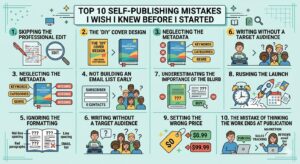
The dream of holding your own book in your hands is a powerful motivator. In today’s digital age, self-publishing has democratized the industry, allowing anyone with a story to become a published author. However, the path from a finished manuscript to a successful book is often riddled with common self-publishing mistakes.
I’ve spent decades working in traditional trade publishing for some of the largest publishing houses in the world. I’ve seen firsthand the rigorous standards and meticulous planning that go into a bestseller. Since migrating to the world of self-publishing, I’ve worked with many authors who initially tried to “go it alone.” They came to me after learning the hard way that enthusiasm doesn’t always equal expertise. I’ve helped them course-correct and salvage their projects, and through their experiences, I’ve identified the most common hurdles.
You’ve invested months, maybe years, of your life into this project. You’ve poured your blood, sweat, and tears into every sentence. After that level of emotional and creative investment, the last thing you want is for your hard work to be ignored because of an avoidable mistake. Here are the top 10 self-publishing mistakes I wish I knew before I started, along with actionable ways to fix them.
1. Skipping the Professional Edit
In the traditional world, a book goes through multiple rounds of professional scrutiny. You are too close to your own work to see the flaws.
-
The Tip: If a full developmental edit is out of budget, hire a copyeditor for a “line-by-line” polish.
-
The Solution: Use tools like ProWritingAid for a technical pass, and find “beta readers” in your genre to catch structural issues before you pay a pro.
2. The “DIY” Cover Design
Readers do judge books by their covers. A homemade cover screams “amateur,” and in a crowded marketplace, you only have milliseconds to make a first impression.
-
The Tip: Browse the Amazon Bestseller list for your specific sub-genre and note the common color palettes and fonts.
-
The Solution: If a custom designer is out of reach, look for “Premade Book Covers” from professional designers; they are high-quality but significantly more affordable.
3. Neglecting the Metadata
This is one of the most invisible self-publishing mistakes, yet it’s the easiest to fix.
-
The Tip: Use tools like Publisher Rocket to see exactly what phrases readers are typing into search bars.
-
The Solution: Don’t just use broad categories like “Fiction.” Go deep into Amazon browse paths (e.g., Fiction > Fantasy > Epic > Dragons).
4. Not Building an Email List Early
Social media is rented space; your email list is the only platform you truly own.
-
The Tip: Create a “Lead Magnet”—a free short story or deleted scene—and put the link to join your list in both the front and back of your book.
-
The Solution: Use a service like MailerLite or Mailchimp to automate a “Welcome Sequence” for new subscribers.
5. Ignoring the Formatting
If your eBook has weird line breaks or your print margins are so tight that readers have to crack the spine to see the words, you’ll get one-star reviews.
-
The Tip: Use software specifically built for authors, such as Vellum or Atticus, to create professional-grade layouts.
-
The Solution: Always send an EPUB file to your own Kindle or e-reader to check the user experience before going live.
6. Writing Without a Target Audience
In trade publishing, we never signed a book without knowing exactly who would buy it. Trying to market to “everyone” is the fastest way to sell to “no one.”
-
The Tip: Write a “Reader Persona.” Give your ideal reader a name, an age, and a list of other authors they like.
-
The Solution: Use Amazon’s “Customers also bought” sections to identify exactly where your book fits in the ecosystem.
7. Underestimating the Importance of the Blurb
Your blurb is your ultimate sales tool. Many authors treat it as a dry summary rather than a high-stakes hook.
-
The Tip: Follow the “Hook, Conflict, Stakes” formula. Hook them in the first sentence, introduce the problem, and tell them what happens if the hero fails.
-
The Solution: Ask for feedback on your blurb in author forums or use A/B testing through Facebook ads to see which version gets more clicks.
8. Rushing the Launch
Many authors make the self-publishing mistake of hitting ‘publish’ too soon.
-
The Tip: Set a release date at least 90 days in the future to allow time for marketing and pre-orders.
-
The Solution: Build a Launch Team (10–20 dedicated readers) who receive an early digital copy in exchange for an honest review on launch day.
9. Setting the Wrong Price
Pricing is a psychological signal. Too cheap looks like “junk”; too expensive looks like “arrogance.”
-
The Tip: For debut eBooks, $2.99 to $4.99 is the industry “sweet spot” for maximizing both royalties and sales volume.
-
The Solution: Run a temporary $0.99 sale via sites like Freebooksy to boost your ranking shortly after launch.
10. The Mistake of Thinking the Work Ends at Publication
Self-publishing isn’t a “set it and forget it” project. You are now a business owner.
-
The Tip: Spend 20% of your time on marketing and 80% on writing the next book.
-
The Solution: Create a marketing calendar. Dedicate small blocks of time each week to social media, ads, or newsletter outreach.
Avoid These Self-Publishing Mistakes and Finish Strong
I’ve seen too many brilliant authors try to navigate this forest alone, only to emerge discouraged and exhausted. Having spent years in the halls of the world’s biggest publishers, I know how much work goes into making a book look “effortless.” You’ve already done the hardest part: you wrote the book. Don’t blow it now by trying to cut corners at the finish line. While the DIY spirit is noble, there is a level of polish that only comes from professional experience. Think of it as an insurance policy for your creativity. At Sprig Publishing Solutions, I combine my decades of traditional publishing expertise with the lessons learned from authors who transitioned from “going it alone” to professional collaboration. We ensure that the “blood, sweat, and tears” you’ve shed are translated into a product that looks, feels, and sells like a masterpiece.